
Newbie
Level 1
XP
Story
Why Do Witches Ride Brooms? The History Behind the Legend
From pagan fertility rituals to hallucinogenic herbs, the story of witches and brooms is a wild ride.
13 views

Akarsh Rajput
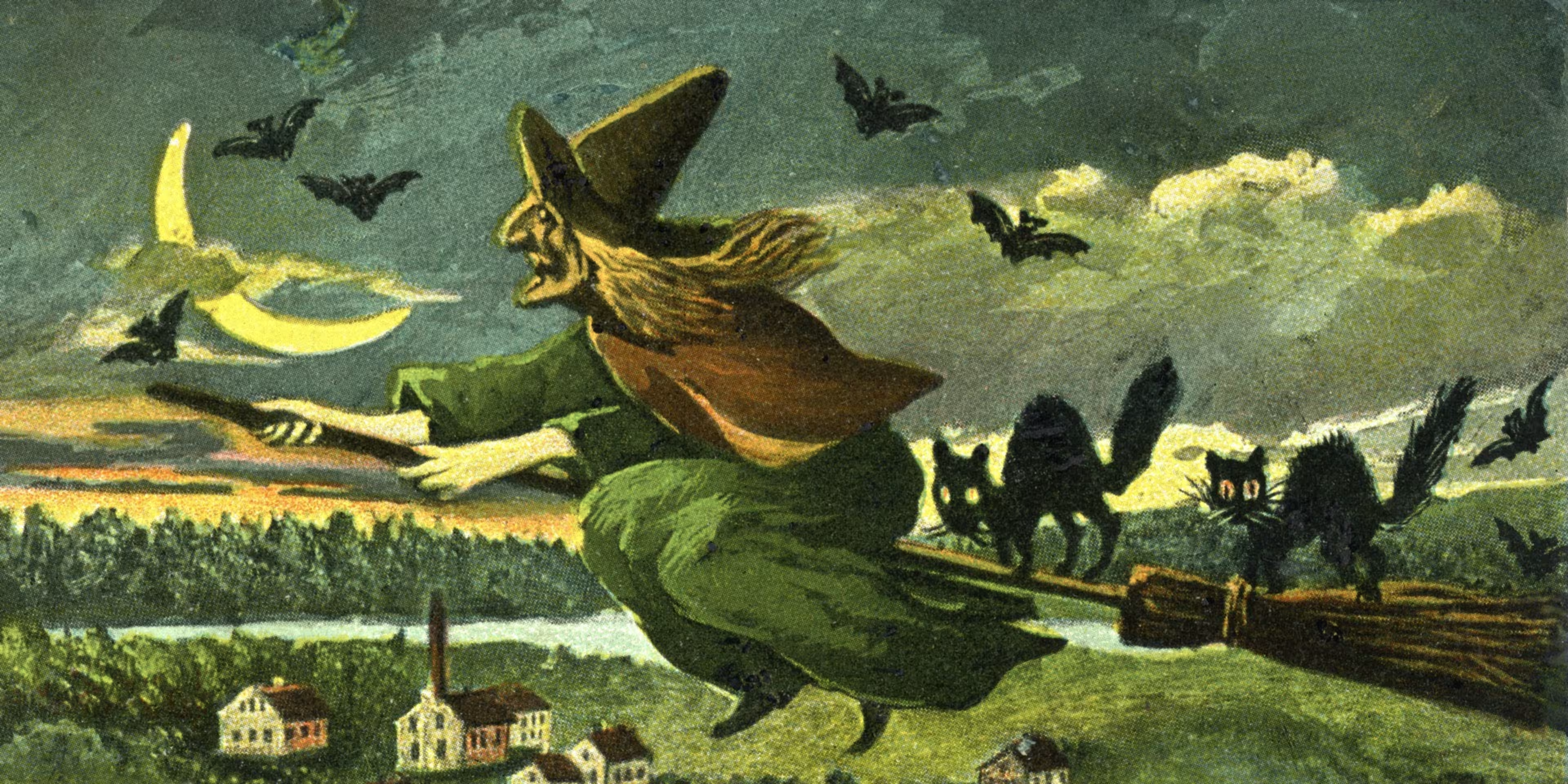
The evil green-skinned witch flying on her magic broomstick may be a Halloween icon—and a well-worn stereotype. But the actual history behind how witches came to be associated with such an everyday household object is anything but dull.
It’s not clear exactly when the broom itself was first invented, but the act of sweeping goes back to ancient times when people likely used bunches of thin sticks, reeds and other natural fibers to sweep aside dust or ash from a fire or hearth. As J. Bryan Lowder writes, this household task even shows up in the New Testament, which dates to the first and second centuries A.D.
Halloween was originally called Samhain and marked the end of the harvest season for Celtic farmers.
The word broom comes from the actual plant, or shrub, that was used to make many early sweeping devices. It gradually replaced the Old English word besom, though both terms appear to have been used until at least the 18th century. From the beginning, brooms and besoms were associated primarily with women, and this ubiquitous household object became a powerful symbol of female domesticity.
Despite this, the first witch to confess to riding a broom or besom was a man: Guillaume Edelin. Edelin was a priest from Saint-Germain-en-Laye, near Paris. He was arrested in 1453 and tried for witchcraft after publicly criticizing the church’s warnings about witches. His confession came under torture, and he eventually repented but was still imprisoned for life.
By the time of Edelin’s “confession,” the idea of witches riding around on broomsticks was already well established. The earliest known image of witches on brooms dates to 1451, when two illustrations appeared in the French poet Martin Le Franc’s manuscript Le Champion des Dames (The Defender of Ladies). In the two drawings, one woman soars through the air on a broom; the other flies aboard a plain white stick. Both wear headscarves that identify them as Waldensians, members of a Christian sect founded in the 12th century who were branded as heretics by the Catholic Church, partly because they allowed women to become priests.
Anthologist Robin Skelton suggests the association between witches and brooms may have roots in a pagan fertility ritual, in which rural farmers would leap and dance astride poles, pitchforks or brooms in the light of the full moon to encourage the growth of their crops. This “broomstick dance,” she writes, became confused with common accounts of witches flying through the night on their way to orgies and other illicit meetings.
Witches were perceived as evil beings by early Christians in Europe, inspiring the iconic Halloween figure.
Broomsticks were also thought to be the perfect vehicles for the special ointments and salves that witches brewed up to give themselves the ability to fly, among other depraved activities. In 1324, when the wealthy Irish widow Lady Alice Kyteler was tried for sorcery and heresy, investigators reported that in searching Kyteler’s house, they found “a pipe of ointment, wherewith she greased a staff, upon which she ambled and galloped through thicke and thin."
Pharmacologist David Kroll writes in Forbes that alleged witches in the Middle Ages were thought to concoct their brews from such plants as Atropa belladonna (deadly nightshade), Hyoscyamus niger (henbane), Mandragora officinarum (mandrake) and Datura stramonium (jimsonweed), all of which would have produced hallucinogenic chemicals known as tropane alkaloids.
According to some historical accounts, rather than ingest these mind-altering substances by eating or drinking, which would have caused intestinal distress, witches chose to absorb them through the skin—often in the most intimate areas of their bodies. In his book Murder, Magic, and Medicine, John Mann cites a 15th-century text by the theologian Jordanes de Bergamo, who wrote that “the vulgar believe, and the witches confess, that on certain days or nights, they anoint a staff and ride on it to the appointed place or anoint themselves under the arms and in other hairy places.”
Log in to comment on this blog.
Loading